

 iDeemlawful
For months, United States intelligence operatives had tracked Venezuelan President Nicolas Maduro’s movements in extraordinary detail.
A compact team, including an insider within Venezuela’s government, monitored where the 63-year-old slept, what he consumed, how he dressed and even, according to senior military officials, “his pets”.
By early December, a covert plan codenamed “Operation Absolute Resolve” had been finalised. The mission followed months of detailed preparation and rehearsals, including elite US forces constructing a life-size replica of Maduro’s Caracas safe house to practise access routes.
The operation — representing a level of US military action in Latin America unseen since the Cold War — was kept under strict secrecy. Congress was neither briefed nor consulted beforehand. Once the final details were locked in, senior commanders waited patiently for ideal conditions to proceed.
MOST READ ARTICLES
Officials said the goal was to preserve maximum surprise. An earlier launch window had opened four days prior after approval from US President Donald Trump, but the mission was delayed due to unfavourable weather and cloud cover.
“Over the weeks through Christmas and New Year, the men and women of the United States military sat ready, patiently waiting for the right triggers to be met and the president to order us into action,” General Dan Caine, the country’s top military officer, told reporters on Saturday morning.
‘Good luck and godspeed’
The presidential order to begin the mission was issued at 22:46 EST on Friday (03:46 GMT Saturday).
“We were going to do this four days ago, three days ago, two days ago, and then all of a sudden it opened up. And we said: go,” Trump told Fox & Friends on Saturday, hours after the overnight operation.
“He said to us, and we appreciate it… good luck and godspeed,” Gen Caine said. The directive was given shortly before midnight in Caracas, allowing US forces to exploit darkness for most of the operation.
What followed was a two-hour, 20-minute assault across air, land and sea that shocked Washington and much of the world.
In both scale and precision, the mission was highly unusual and triggered swift condemnation from several regional leaders. Brazil’s President Lula da Silva said the forceful seizure of Venezuela’s leader created “yet another extremely dangerous precedent for the entire international community”.
Trump did not monitor the mission from the White House Situation Room. Instead, he observed a live feed from his Mar-a-Lago residence in Palm Beach, Florida, alongside CIA Director John Ratcliffe and US Secretary of State Marco Rubio.
“It was an incredible thing to see,” Trump said on Saturday. “If you would have seen what happened, I mean, I watched it literally like I was watching a television show. And if you would’ve seen the speed, the violence… it’s just, it was an amazing thing, an amazing job that these people did.”
In recent months, the US had surged thousands of troops into the region, alongside an aircraft carrier and dozens of warships, marking the largest military build-up in decades. Trump has repeatedly accused Maduro of drug trafficking and narco-terrorism, and US forces have destroyed numerous small vessels alleged to be transporting narcotics.
The first visible signs of Operation Absolute Resolve appeared in the skies. According to US officials, more than 150 aircraft — including bombers, fighter jets and surveillance planes — were deployed throughout the night.
“It was very complex, extremely complex, the whole manoeuvre, the landings, the number of aircraft,” Trump told Fox News. “We had a fighter jet for every possible situation.”
Explosions echoed across Caracas around 02:00 local time (06:00 GMT), with thick smoke rising above the city. “I heard a huge sound, a loud bang,” journalist Ana Vanessa Herrero told the BBC. “It moved all the windows. Immediately after I saw a huge cloud of smoke that almost blocked the entire view.”
She added: “Planes and helicopters were flying all over the city.”
Videos soon flooded social media, showing aircraft swarming overhead and scenes believed to be the aftermath of strikes. One clip showed helicopters flying low over Caracas as smoke billowed from multiple sites.
“We woke up at around 01:55 to the roar of explosions and the hum of planes flying over Caracas,” a resident, Daniela, told the BBC. “Everything was plunged into absolute darkness, illuminated only by the flashes of nearby detonations.”
She added: “Neighbours were messaging in the condominium group chat, all confused and unaware of what was happening [and] frightened by the blasts.”
US officials later confirmed strikes at five locations, including Generalissimo Francisco de Miranda Air Base, La Carlota airfield and Port La Guaira, Caracas’ key maritime gateway.
A map released showed strike zones across Caracas and nearby areas, including Fuerte Tiuna, La Carlota, Port La Guaira and Higuerote Airport.
Some strikes targeted air defence installations and military assets, officials said. Trump also suggested the city’s power supply had been disrupted before the operation, though details were not disclosed.
“The lights of Caracas were largely turned off due to a certain expertise that we have,” he said. “It was dark and it was deadly.”
‘They knew we were coming’
As explosions rocked the capital, US ground forces advanced into Caracas. Among them were Delta Force operators, the military’s premier special mission unit, according to sources cited by CBS. They were heavily armed and carried a blowtorch to breach reinforced doors if required.
Gen Caine said the troops reached Maduro’s compound shortly after the strikes began at 02:01 local time. Trump described the location as a fortified military “fortress”, adding: “They were in a ready position waiting for us. They knew we were coming.”
The troops encountered resistance upon arrival, and one US helicopter was struck but managed to remain airborne. “The apprehension force descended into Maduro’s compound and moved with speed, precision and discipline,” Gen Caine said.
“They just broke in, and they broke into places that were not really able to be broken into, you know, steel doors that were put there for just this reason,” Trump added.
As the raid unfolded — during which Maduro’s wife, Cilia Flores, was also detained — Rubio began informing lawmakers, a move that later sparked criticism in Congress.
“Let me be clear: Nicolas Maduro is an illegitimate dictator. But launching military action without congressional authorisation and without a credible plan for what comes next is reckless,” Senate Democratic leader Chuck Schumer said.
Rubio defended the timing, saying early notification could have jeopardised the mission. “Congress has a tendency to leak,” Trump added. “This would not be good.”
Inside the compound, Trump said Maduro attempted to flee to a secure room as US troops closed in.
“He was trying to get to a safe place, which wasn’t safe, because we would have had the door blown up in about 47 seconds,” Trump said.
“He made it to the door. He was unable to close it. He got bum rushed so fast that he didn’t get into that [room].”
Asked whether Maduro could have been killed if he resisted, Trump replied: “It could have happened.”
On the US side, Trump said “a couple of guys were hit”, but no American service members were killed.
In a statement on Sunday, Venezuela’s Defence Minister Vladimir Padrino said a “large part” of Maduro’s security detail, along with “soldiers and innocent civilians”, were killed during the operation.
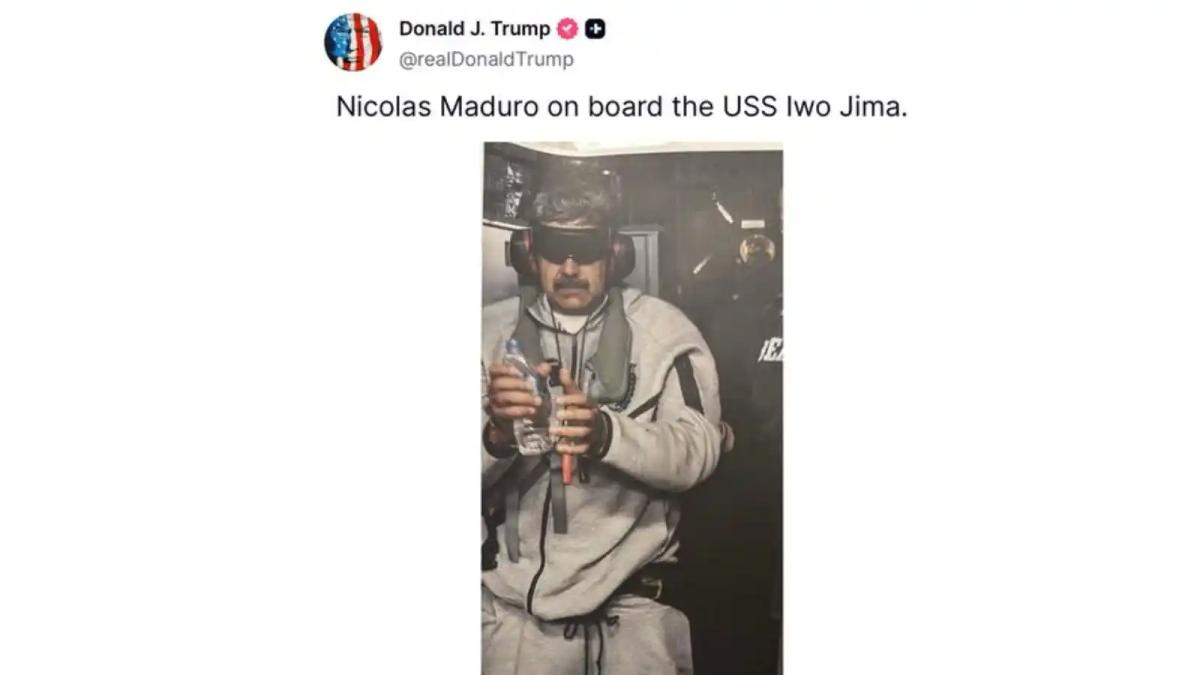
The US had previously placed a $50m (£37m) bounty for information leading to Maduro’s arrest. By 04:20 local time on Saturday, helicopters were departing Venezuelan airspace with Maduro and his wife in custody of the US Department of Justice, bound ultimately for New York to face criminal charges.
Nearly an hour later, Trump announced the capture publicly. “Maduro and his wife will soon face the full might of American justice,” he said.
BBC