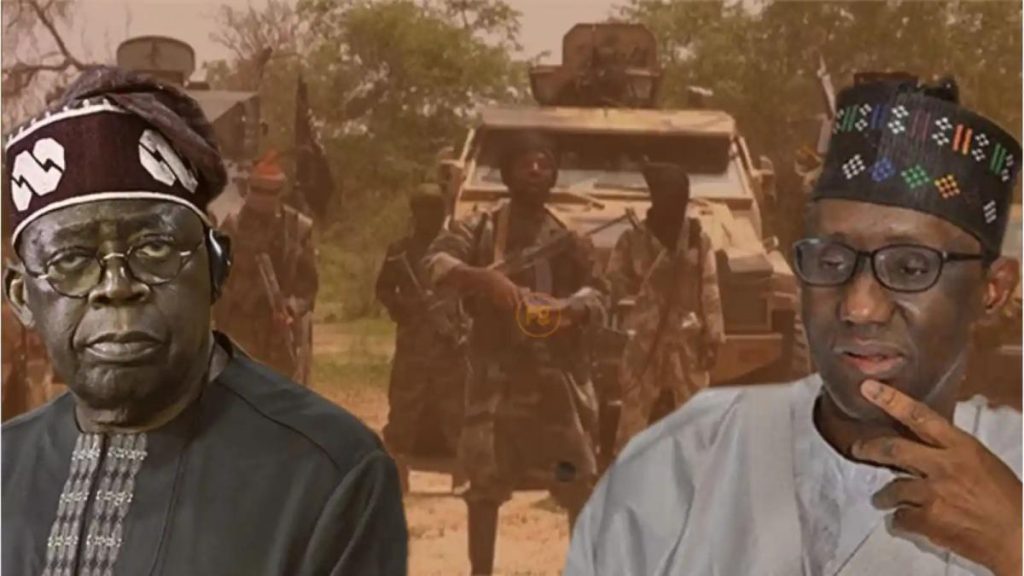
A high-level counter-terrorism mission personally sanctioned by former President Muhammadu Buhari has returned to the spotlight after startling disclosures by retired Army General Ali-Keffi, a former 1 Division commander and General Officer Commanding (GOC).
Ali-Keffi was selected in 2021 to head Operation Service Wide (OSW), a multi-agency investigative platform tasked with identifying Boko Haram coordinators, uncovering financial sponsors, and disrupting networks enabling the insurgency.
But according to the retired general, the investigation uncovered far-reaching findings. It exposed an extensive chain of financiers allegedly connected to senior officials, influential military figures, and major financial operators. He claimed a broad campaign soon emerged to stall the probe, shield prominent individuals, and suppress those driving the operation.
NFIU’s Secret Briefing to Buhari: The Turning Point
Information confirmed by SaharaReporters indicates that OSW, in partnership with the Nigerian Financial Intelligence Unit (NFIU), arrested several notable suspects in March 2021. The arrests stemmed from detailed financial tracking tied to terrorism funding.
These discoveries were formally submitted to Buhari in September 2021 through the NFIU. Ali-Keffi said former Chief of Army Staff General Faruk Yahaya (rtd.) played a major role in the briefing, even though information later connected him to one of the detainees.
Ali-Keffi explained that the following month, he was unexpectedly invited to the Headquarters of Military Police. On October 18, 2021, he reported there, but was held for several hours under prolonged questioning.
He was subsequently detained for 64 days without charges, queries, or trial in either a military or civilian court before being forced into retirement.
“Till today, I don’t know my offence,” he said, maintaining that his detention was aimed at stopping the terror-funding investigation.
He added that no response was given to his petition to President Bola Tinubu seeking intervention, prompting him to go public and file a case at the National Industrial Court.
He stated that the court has yet to sit even once, alleging that filings were not served on the Nigerian Army and that his lawyer believes there is “foul play.”
Powerful Individuals Allegedly Linked to Suspects
General Ali-Keffi stressed that his claims were not speculative but based on information conveyed directly by the NFIU’s former Director/CEO, Modibbo Hamman-Tukur Ribadu, who worked closely with OSW.
He said two suspects arrested by OSW were linked to former Chief of Army Staff, Lt. Gen. Tukur Buratai (rtd).
He added that two others were linked to former Attorney-General of the Federation, Abubakar Malami (SAN), while one was connected to former Central Bank Governor, Godwin Emefiele.
Gen. Faruk Yahaya (rtd.) was tied to one suspect.
“I am not accusing Buratai, Malami, or Emefiele of terrorism financing,” Ali-Keffi clarified.
“But I was informed by the former NFIU Director that investigations linked them to some of the suspects. I don’t know if they were later cleared but up to the time that I was arrested, detained, compulsorily retired and taken off the OSW, they were linked to some of the suspects.”
He further claimed that Buratai requested the then-NFIU chief to “prevail on me to release two suspects.” Ali-Keffi said he declined and instead reported directly to Buhari without naming Buratai.
He said Buhari reacted sharply, telling him, “You report to me and to me alone.”
He emphasized that none of these officials were directly implicated in terrorism.
He stated, “Let me state again that the former Director of NFIU told me that Gen. Buratai, Malami, Emefiele and Gen. Yahaya respectively were linked to some of the suspects based on business connections.
“Note that a lot of the suspects were engaged in legitimate business, which was Bureau De Change which however, we suspected were ‘cover’ for their other nefarious activity, which was, terrorism financing.
“Throughout the time that I headed the OSW, we did not establish that Gen. Buratai, Emefiele, Malami and Gen. Yahaya, were linked with terrorism financing or knew that the suspects that they were linked with were involved in terrorism financing.”
$600 Million Offshore Account And Attempted $50 Million Bribe
One of the foreign suspects, Aboubacar Hima, held an offshore account with about $600 million, traced through the NFIU. The Nigerian team alerted the United States, whose Financial Intelligence Unit froze the account.
Ali-Keffi said he later learned from the NFIU head that someone representing Hima offered $50 million for Nigeria to notify U.S. authorities that it had “no issues” with the funds, which would restore access to the account.
He said he rejected the proposal.
After his release from detention, he learned that the Nigerian government eventually wrote to the U.S. seeking to unfreeze the account.
He added that Buhari instructed the NFIU head to “reconcile with Malami” over their disagreements.
Efforts to Derail Investigation
Ali-Keffi noted that OSW had gathered substantial evidence to prosecute 48 suspects for terrorism financing. However, he said he faced continuous pressure to downgrade the charges to money laundering, which he believed was intended to shift the case to the EFCC—then under Malami’s influence and led by Abdulrasheed Bawa, Malami’s relative.
He alleged that a senior prosecution lawyer assisting OSW was removed without explanation after refusing to back down from her view that terrorism-financing charges were justified.
He said the AGF’s office did not secure required court orders for asset forfeiture and instead sought only detention orders.
According to him, the presidency and influential officials “wanted to kill the investigation.”
“After my release from detention, I was told by Hamman-Tukur Ribadu that the Nigerian Government wrote to the US to unfreeze the account,” he said.
“Let me state that in the course of the investigation, sometime in August or September 2021, Abubakar removed one of the top prosecution lawyers who was assisting the OSW to build up the case without any explanation to me. I later learned that she refused to compromise her stance, which was that we (OSW) had sufficient evidence to present in court on charges of terrorism financing against all the 48 suspects that were in OSW custody.
“I recall that I stated in my letter of redress that pressure was being mounted on me to build a case of money laundering against the individuals and not terrorism financing.
“I suspected that the powers-that-be at the time wanted the case to be transferred to the EFCC, which is under the control of the Attorney General. The Chairman at the time was Mr Bawa, a relative of Malami.
“They wanted to ‘kill’ the investigation but my insistence and that of the lady from the AGF office, who was removed, made the Presidency to go after me by getting the Army to come up with trumped-up allegations against me.”
Release of the Suspects After His Removal
After Ali-Keffi’s removal, detention, and forced retirement, OSW operations were effectively stopped.
He said all suspects arrested by OSW were eventually freed.
None of the 20 top suspects, nor any of the others detained, were prosecuted.
He added that the detainees were reportedly warned not to speak publicly or pursue legal action over their nine-month detention.
He said an insider confirmed these developments to him.
“I understand that the 20 suspects were never charged or taken to court. They were all released. I was made to understand from an insider that they (the suspects before they were released) were warned not to go to the media, or to go to the court as a result of their detention for over nine months. NFIU was pressured to drop the accusation of terrorism financing,” he said.
List of Over 400 Targets, Including Boko Haram Leader Shekau
Ali-Keffi also revealed that OSW had compiled a list of more than 400 individuals to be arrested or neutralized.
The list included Boko Haram’s late commander, Abubakar Shekau.
“Some of the 20 top suspects are part of the 48 that the OSW arrested,” he said.
“We had a list of suspects to be arrested or eliminated containing over 400 individuals. Shekau was in the list. Of course, we couldn’t arrest Shekau and so we ’engineered’ what happened to him.”
Ali-Keffi said the NFIU, EFCC, and the Office of the Attorney-General are best placed to clarify whether funds traced to the suspects were recovered or released.
He maintains that his arrest, detention, and compulsory retirement stemmed directly from his refusal to support efforts to derail an investigation that implicated some of Nigeria’s most influential figures.