

 iDeemlawful
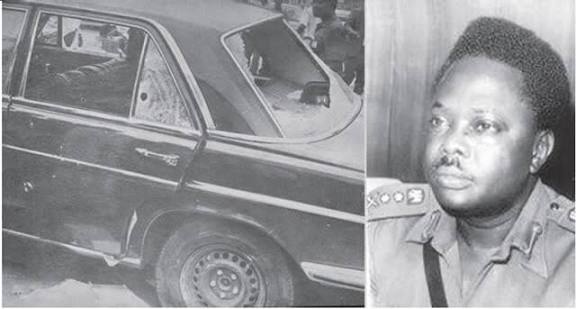
2026 marks 50 years since the assassination of former Head of State, Murtala Muhammed. One of the eyewitnesses to the killing and his former orderly, Michael Otuwe (retd.), has shared his account of the failed 1976 coup.
News Region gathered that in an interview with the retired soldier, he detailed how the military leader nearly escaped his attackers, his wartime experiences, and the personal sacrifices that defined his years of close service to one of Nigeria’s most respected military figures.
In an interview with Daily Trust, Otuwe said, “I am an Igala man from Olamoboro Local Government of Kogi State. I attended Ankpa Primary School and Ankpa Model Secondary School before I joined the profession I cherished most, the army.”
He explained that he enlisted in the Nigerian Army on September 11, 1967, at Ikeja Military Cantonment in Lagos, undergoing six months of training on the eve of the Nigerian Civil War.
MOST READ ARTICLES
“After the training I was posted to the Nigerian Army Signal Corps and incidentally, Murtala Ramat Mohammed was a Colonel then and the Inspector of Signals,” he added.
Otuwe said Muhammed selected him personally due to his discipline and neat appearance.
“He told me that he noticed how immaculate I was in my army dress when we do master parade. He picked me to be his orderly when I was a Lance Corporal,” he said.
He stated that he worked closely with Muhammed across several postings, including during the civil war when the late General became the first General Officer Commanding of the Second Division of the Nigerian Army.
“I worked with him till he was killed, and that was 11 years,” Otuwe said, noting that within that period the General had three children, Aisha, Zakari and Fatima.
Otuwe described Muhammed as a disciplined and strategic commander.
“He was an organiser of men and their welfare. He was smart and hardworking and thought of Nigeria first before anything,” he said.
He recalled a moment when Biafran forces surrounded them.
“He did a wonderful tactical manoeuvre and retreated that baffled even we that were with him. When many wanted to surrender, he made a quest to fight and to win for Nigeria to continue as a united country.”
Surviving Ambushes
The retired soldier narrated several ambushes during the war. He said, “We encountered many ambushes and attacks but one of the most memorable was when we were encircled at Ukpo Junction in Abbagana. Murtala did a tactical manoeuvre and withdrew and prepared for a defensive attack that led to the capture of many towns and cities.”
Otuwe added that after certain operations, troops advanced through Asaba and later moved to Idah in present-day Kogi State to prepare for further offensives.
“In 1968, there was a reshuffle that took General Murtala back to Lagos as Minister of Communications and Inspector of Signals. That meant he was doing two jobs at the same time,” he said.
Murtala’s assasination
Recounting the day of the assassination, Otuwe said, “He was assassinated on July 29, 1976 (Starts shedding tears). He ruled for six months from July 29, 1975, to February 13, 1976.
“He was a very good man, as he did not allow the goods (personal effects) of General Gowon to be thrown out, but to be removed gently, and for the house to be renovated before he relocated from Dodan Barracks.
“That was why he was shuttling from Ikoyi without pilot cars, motorbike outriders, armed military and security bodyguards among others. He only rode in the official Mercedes-Benz car with two flags, the national flag on the left and the armed forces flag on the right.
“On that fateful day, we passed through the Federal Secretariat in Ikoyi, which was undergoing renovation and covered with zinc.
“When we reached Alagbgon Junction, the traffic man did not notice the flags, he would have allowed the traffic in our direction to continue moving, but he stopped the five or six cars in front of us then I saw some people in agbada (Babanriga) and when they lifted them up they brought out AK-47 rifles and fired at us.
“Already a masked man had got the driver, Sergeant Adamu Michika, in the head and he feel on the arm-rest where the suit case containing the General’s mufti was. I took cover and fell on the driver.
“The General and the ADC also took cover. When the assassins left and were heading to the National Broadcasting Corporation, Radio House, to announce the takeover, one of the Majors turned and saw that when the ADC opened the door to help the General, the Major shouted and notified his colleagues that they were alive.
“This made them turn and rush back and empty their bullets at us. I was the only survivor as I was shot in the arm and the hip.
“The troops loyal to General Murtala came after the soldiers and they took us to the mortuary. I recovered from coma when the breeze from the air conditioner and the pain woke me up.
“A mortuary attendant noticed that I raised my hand, and he alerted a doctor, who said I was alive, and they took me to Dodan Barracks and then to a hospital on Awolowo Road, Ikoyi.”
Speaking on his recovery, the retired soldier said, “I spent six months recovering and resumed work with the Nigerian Army Signal Corps. Where I worked with Generals Adenaju, Raji Rasaki and lastly Tanko Ayuba.
Asked whether he received any honour, he replied, “No, not at all.”
Sharing his living condition, Otuwe said, “I am now staying in a rented two-bedroom house in Maraba in Nasarawa State. The street has no name not to talk of house number. But I am working in the office of Riskua Murtala Muhammed in Maitama.”
Otuwe noted that he retired from service on December 31, 1999, as a Master Warrant Officer.
On whether he regretted joining the Nigerian Army, Otuwe said: “No, no, no, not at all.”